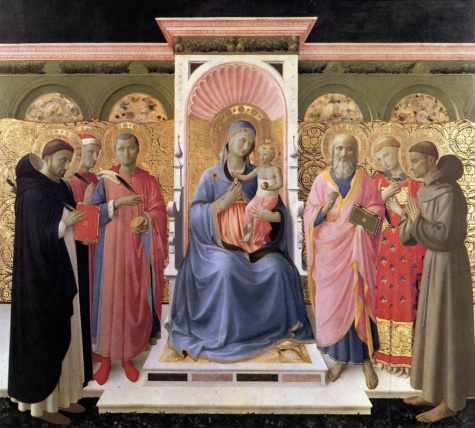
 Fra. Angelico, a member of the preaching order of the Dominicans, is credited with introducing into the Western, Christian imagination the conceit of “sacra conversazione.” Saints from the Bible, the distant and recent past are shown gathered around the Madonna and Christ-child in animated conversation. Holding texts for ready reference, they listen, speak and respond in a timeless conversation initiated by scriptures.
In the “Angelina Altarpiece,” (above), in the Convent of San Marco, Florence, Fra. Giovanni de Fiesole (c.1400-1455, nicknamed Fra. “Angelico”), depicts St. Peter Martyr, a dynamic preacher ranked with Dominic himself and martyred in 1251, with Saints Comas and Damian, twins martyred in 303, along with St. John, the gospel writer, and St. Lawrence, martyred in 258, with the beloved St. Francis of Assisi, d.1226. The sacred texts inspire lively interpretation across the ages.
- POSTMODERN PREACHING…
…rediscovers direct engagement between scripture and the whole human experience within the timeless conversation of tradition. Human concerns and questions are recognized and addressed in the biblical texts which know the human condition thoroughly and,simultaneously, bear witness to the holy. The preacher hosts a “sacred conversation” between all past texts and the present occasion they are read and interpreted in public.
- THIS SITE …
… offers a precis of the appointed Biblical readings in the Revised Common Lectionary with commentary inspired by postmodern writers; see the listing to the right. Books important to the site are under the tab on the upper right corner. Some useful and compatible blogs and sites are linked, above right.
“Other voices are at once the past and future of my own voice. The past because they have already called me and even named me, they have already addressed themselves to me, and through their immemorial past, immemorial as far as I am concerned since they preceded the I, they have always already gathered lights, no matter, how obscure, in the place that becomes, little by little, my place. Future of my voice also, since it is only through them that I can learn to speak and to say something.”
Jean-Luis Chretien, The Call and the Response, p.81
“You may say something new and yet it must be old. In fact you must confine yourself to saying old things– and all the same it must be something new! Different interpretations must correspond to different applications. A poet too has constantly to ask himself: ‘but is what I am writing really true?’– and does this necessarily mean: ‘is this how it happens in reality?’ Yes, you have to assemble bits of old material. But into a building.”
Ludwig Wittgenstein, Culture and Value, p.40e
“…[D]econstruction has this peculiarity: if we look back at its origin in the text of [Heidegger’s] Being and Time, it is the last state of the tradition– its last state of transmission, to us and by us, of the whole tradition in order to bring it back into play in its totality. To put the tradition into play according to deconstruction, according to Destruktion, a term Heidegger was determined to protect against Zerstorung, i.e. against ‘destruction,’ and that he characterized as Abbau,‘taking apart’) means neither to destroy in order to form anew nor to perpetuate– two hypotheses that would imply a system given as such and untouchable as such. To deconstruct means to take apart, to dissemble, to loosen the assembled structure in order to give it some play to the possibility from which it emerged, qua structure, it hides.”
Jean-Luc Nancy, Dis-Enclosure: The Deconstruction of Christianity, p.141
“There always has to be something to make the human connection between human beings and God, and that something often consists of words (we humans are speakers and thinkers, after all)– words of prayers and, sometimes, even the words of of theological doctrines and ideas. But those words are really the frail filament through which the electric current passes. Without them it would not passes at all, of course; but they are frail nonetheless.”
James L Kugel, How to Read the Bible: A Guide to Scripture Then and Now, p. 688
“Deconstruction turns on a certain pledging of itself to the future, on a certain religio that religiously observes its covenant with the revenant and arrivant, to what is coming back from the past, and to what is arriving from the past as future.”
John Caputo, The Prayers and Tears of Jacques Derrida: Religion Without Religion, pp 149-150
“While I have never been able to get a handle on [David Foster] Wallace’s notion of spirituality, I think it is a mistake to view him as anything other than a religious writer. His religion, like many, was a religion of language. Whereas most religions
deify only certain words, Wallace exalted all of them.”
Tom Bissell, from the Introduction to the Twentieth Anniversary edition of Infinite Jest, (forthcoming)